Home > In-depth Study Path > Segment 3: Evaluating Mathematical Statements: Always, Sometimes, or Never True
Segment 3: Evaluating Mathematical Statements: Always, Sometimes, or Never True
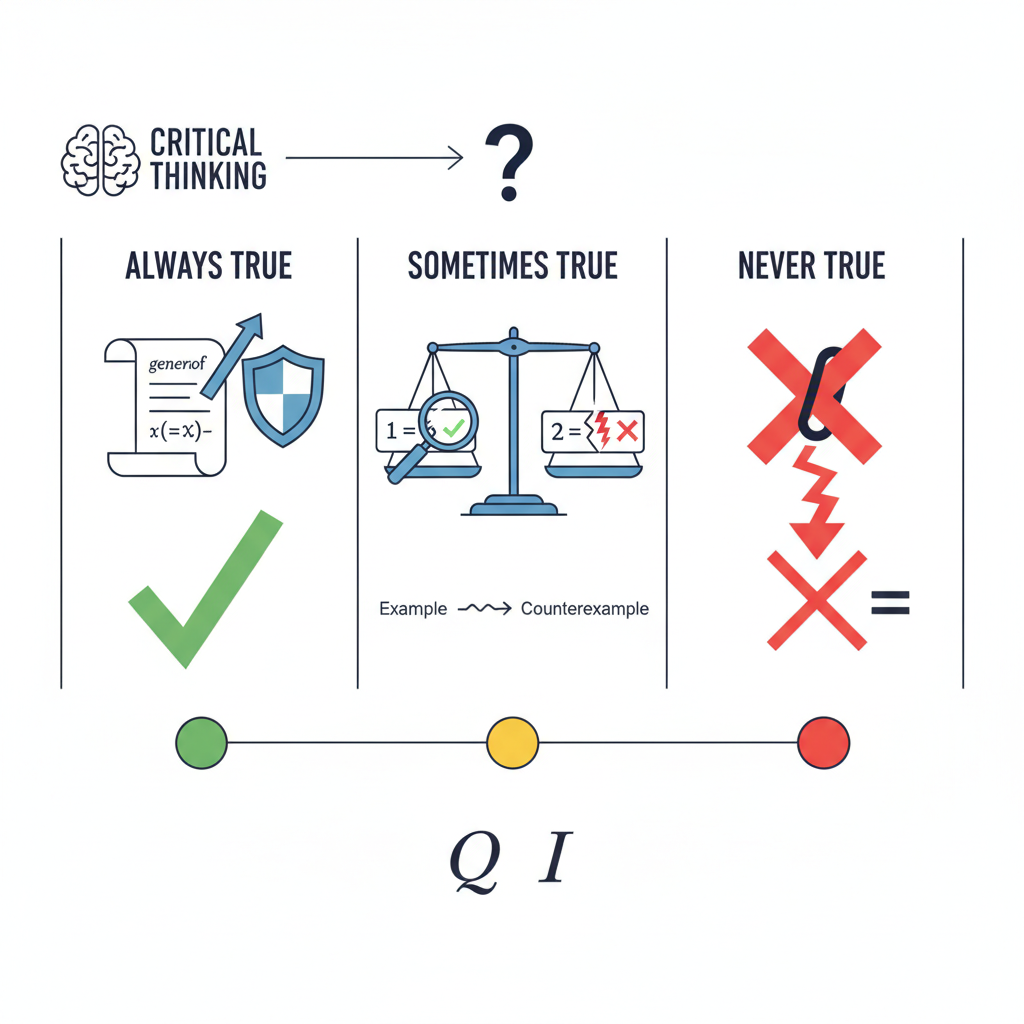
This segment introduces a critical thinking framework for evaluating mathematical statements. Students classify statements about rational and irrational numbers into one of three categories:
- Always True: The statement holds for every conceivable instance. To prove a statement is ‘Always True’ requires a general mathematical proof, not just numerous examples.
- Sometimes True: The statement holds for at least one specific instance, but it also fails for at least one other instance. To establish ‘Sometimes True,’ students must provide both a true example and a counterexample (an example where the statement is false).
- Never True: The statement does not hold for any possible instance. Like ‘Always True,’ proving a statement is ‘Never True’ requires a general mathematical proof.
Students are encouraged to form conjectures (educated guesses) based on exploring a wide range of diverse numerical examples, including integers, fractions, negative numbers, various radicals, and . A key learning objective is distinguishing between merely finding supporting examples and constructing a rigorous argument or proof, recognizing that limited empirical evidence is insufficient for ‘Always’ or ‘Never True’ classifications.
⬅️ Previous: Segment 2: Properties of Operations with Rational and Irrational Numbers | ➡️ Next: Segment 4: The Formative Assessment Cycle and Pedagogical Strategies