Home > In-depth Study Path > Segment 4: The Formative Assessment Cycle and Pedagogical Strategies
Segment 4: The Formative Assessment Cycle and Pedagogical Strategies
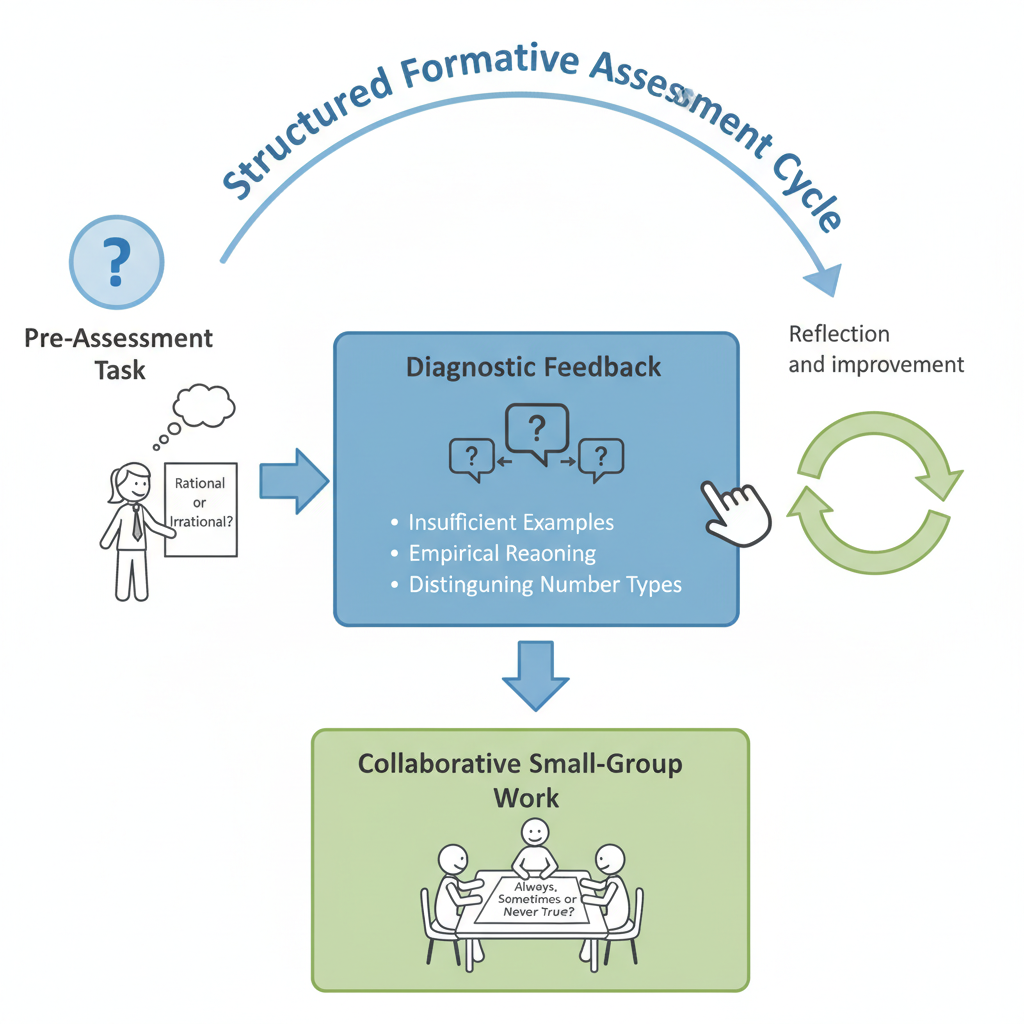
The lesson unit employs a structured formative assessment cycle to facilitate deep learning. It begins with a pre-assessment task (‘Rational or Irrational?’) where students work individually to demonstrate their initial understanding. The teacher then provides non-scoring, diagnostic feedback, typically in the form of guiding questions, to prompt student reflection and improvement rather than simply assigning a grade. This proactive approach aims to address ‘common issues’ such as students providing insufficient examples, exhibiting empirical reasoning (drawing broad conclusions from too few examples), or struggling to distinguish between number types.
The core of the lesson involves collaborative small-group work (‘Always, Sometimes or Never True?’), where students actively experiment with numbers, formulate conjectures, and justify their reasoning on shared posters. This is followed by a whole-class discussion, allowing groups to explain their classifications and critique the arguments of others, thereby solidifying their understanding of mathematical argumentation (aligned with CCSS Mathematical Practice Standards, particularly MP3 and MP6). Finally, students revisit and improve their initial solutions and complete a similar task to demonstrate growth and transfer of learning, reinforcing the cycle of assessment, feedback, and refinement.
⬅️ Previous: Segment 3: Evaluating Mathematical Statements: Always, Sometimes, or Never True