Home > In-depth Study Path > Segment 2: Properties of Operations with Rational and Irrational Numbers
Segment 2: Properties of Operations with Rational and Irrational Numbers
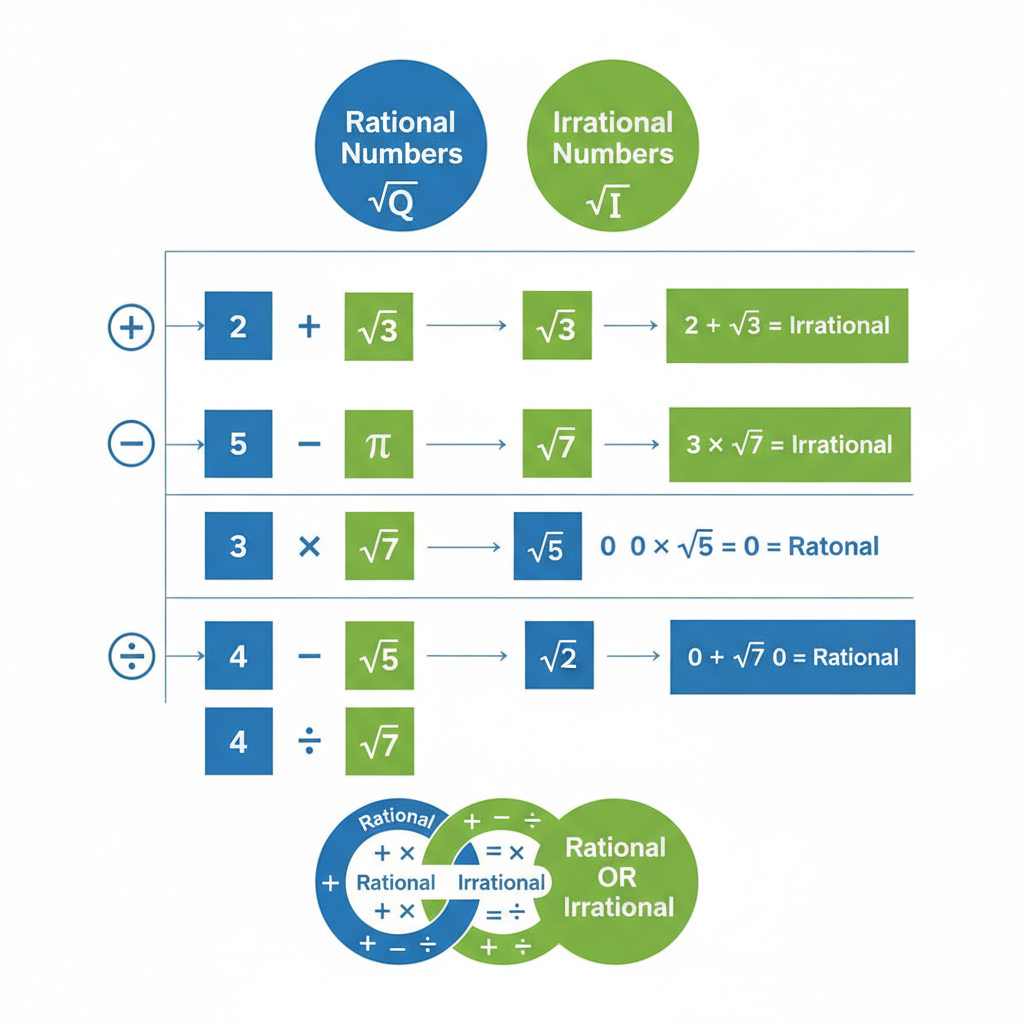
Building upon the definitions, this segment explores how rational and irrational numbers behave under basic arithmetic operations: addition, subtraction, multiplication, and division. While operations involving only rational numbers always result in a rational number, combinations with irrational numbers can yield varied outcomes.
- Rational + Irrational = Irrational: (e.g., )
- Rational - Irrational = Irrational: (e.g., )
- Rational * Irrational = Irrational (unless the rational number is zero, e.g., ; , which is rational).
- Rational / Irrational = Irrational (unless the rational number is zero, e.g., ; , which is rational).
The most complex interactions occur when two irrational numbers are operated upon, as the result can be either rational or irrational.
- Irrational + Irrational: Can be rational (e.g., ) or irrational (e.g., ).
- Irrational * Irrational: Can be rational (e.g., ) or irrational (e.g., ).
Students must move beyond simple assumptions and test various examples to fully grasp these properties, recognizing that some operations with irrationals are not closed.
⬅️ Previous: Segment 1: Defining and Distinguishing Rational & Irrational Numbers | ➡️ Next: Segment 3: Evaluating Mathematical Statements: Always, Sometimes, or Never True