Home > In-depth Study Path > Segment 1: Defining and Distinguishing Rational & Irrational Numbers
Segment 1: Defining and Distinguishing Rational & Irrational Numbers
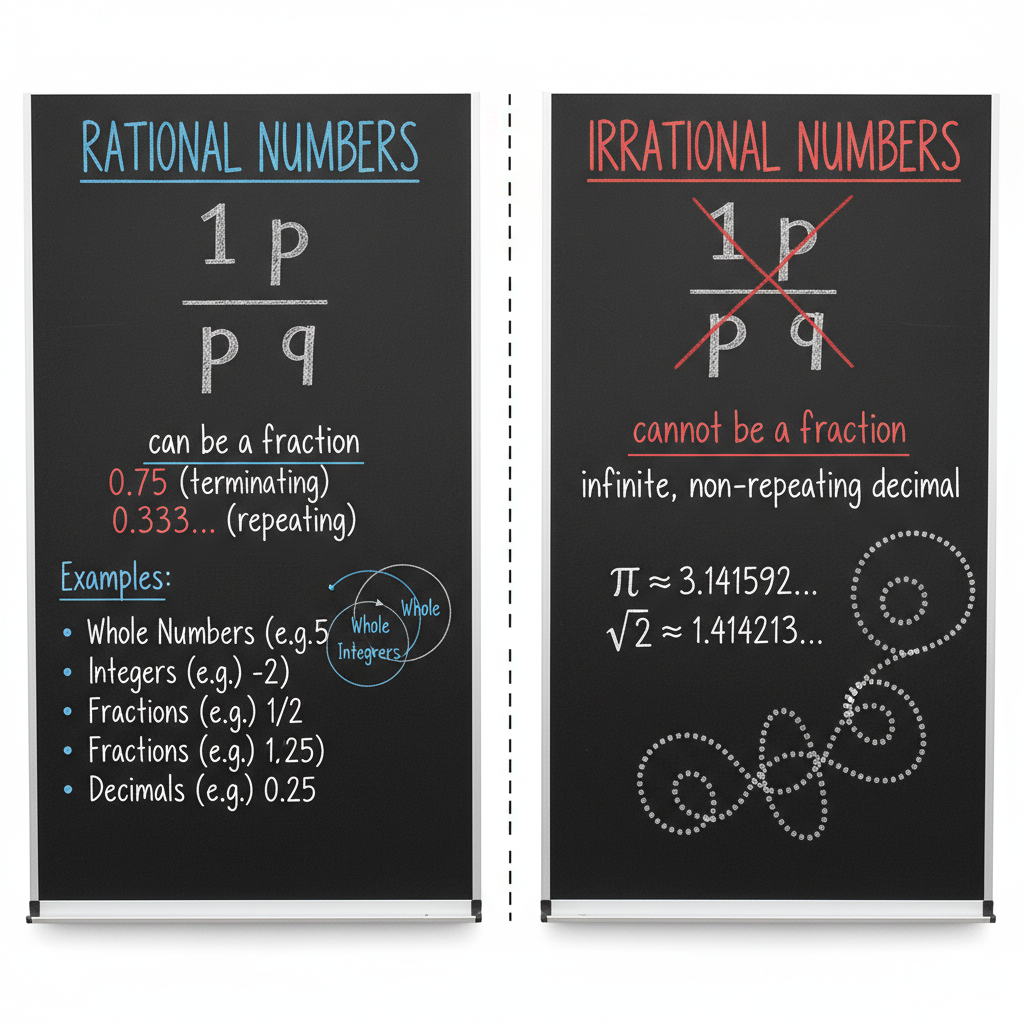
This foundational segment focuses on establishing a clear understanding of rational and irrational numbers. A rational number is defined as any number that can be expressed as a fraction , where and are integers and . In decimal form, rational numbers either terminate (e.g., ) or repeat in a predictable pattern (e.g., ). Examples include whole numbers, integers, fractions, and terminating/repeating decimals.
Conversely, an irrational number cannot be expressed as a simple fraction. Their decimal representations are infinite, non-repeating, and non-terminating (e.g., , ). Understanding the distinction, particularly through examining their decimal forms and ability to be written as a ratio, is crucial. Students are often asked to provide examples and explanations in their own words, highlighting their grasp of these core definitions. Common difficulties in this area include providing incomplete definitions or confusing characteristics of the two number types.
➡️ Next: Segment 2: Properties of Operations with Rational and Irrational Numbers