Home > Summary & Key Points
Summary & Key Points
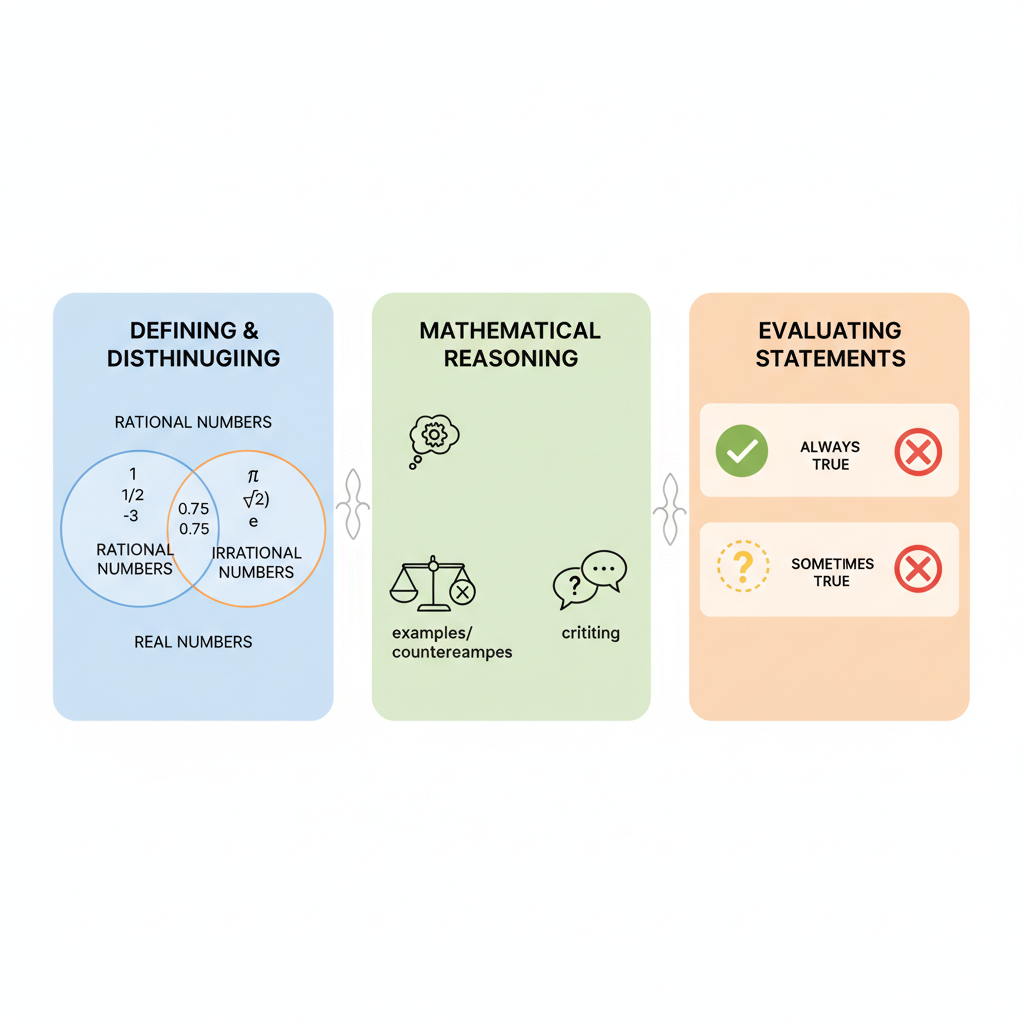
Summary of Main Topics
The provided document outlines a comprehensive formative assessment lesson unit titled “Evaluating Statements about Rational and Irrational Numbers.” Its core purpose is to assess and enhance students’ abilities to reason about the properties of rational and irrational numbers.
The lesson design emphasizes:
- Defining and Distinguishing: Helping students accurately define and differentiate between rational and irrational numbers.
- Mathematical Reasoning: Developing students’ skills in constructing viable arguments, identifying appropriate examples/counterexamples, and critiquing the reasoning of others.
- Evaluating Statements: Classifying mathematical statements concerning rational and irrational numbers as “Always True,” “Sometimes True,” or “Never True.”
- Collaborative Learning: Utilizing small-group work and whole-class discussion to foster deeper understanding and allow students to articulate and justify their mathematical thinking.
- Formative Feedback: Guiding teachers to assess student work for common misconceptions and provide targeted, non-scoring feedback to help students improve their solutions.
- Application: Applying the properties of these number types to solve problems, such as determining the rationality of perimeter and area for geometric figures.
Top 5 Key Takeaways
- Precision in Defining Number Types: A clear and precise understanding of rational numbers (expressible as a fraction of integers, terminating or repeating decimals) and irrational numbers (non-terminating, non-repeating decimals) is foundational for all subsequent reasoning.
- Evidence Beyond Examples: While examples are crucial for exploring mathematical statements, a few confirming examples do not prove a statement is “always true” or “never true”; rigorous proof is required for these categories, whereas “sometimes true” is established by finding one true and one false instance.
- Diverse Numerical Exploration is Key: Effective evaluation of statements about rational and irrational numbers necessitates testing a wide variety of numerical examples, including positive/negative integers, fractions, square roots, and transcendental numbers like , to uncover the full scope of possibilities and potential counterexamples.
- Impact of Operations Varies: The sum, difference, product, or quotient of rational and irrational numbers does not always result in a predictable type (e.g., the sum of two irrational numbers can be rational or irrational), requiring careful case-by-case analysis.
- Formative Assessment as a Learning Tool: The lesson structure highlights that identifying student difficulties and providing targeted feedback before formal grading, combined with collaborative problem-solving, is a powerful strategy for improving students’ conceptual understanding and mathematical reasoning skills.
See also: 02_Outline, 04_Glossary